
Rock Art
The enigmatic marks and their landscape settings
For over 25 years I’ve explored rock art sites in some of the most spectacular landscapes of the British Isles, often collaborating with researchers like Professor Richard Bradley. Our investigations asked… why was so much effort invested in carving these enigmatic marks?
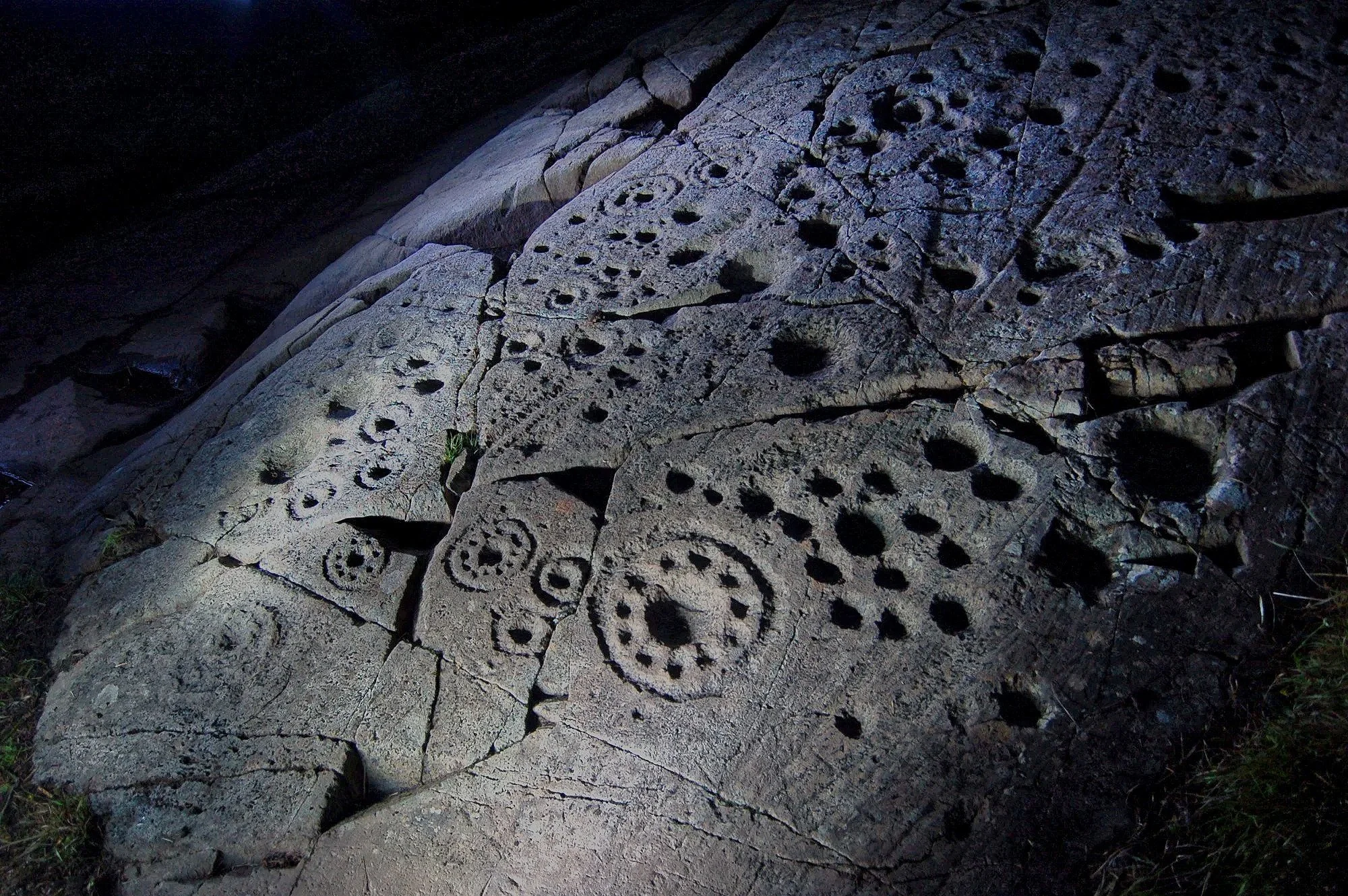
Carved between 4,000 and 5,000 years ago, cup-and-ring marks and related motifs are among the most distinctive forms of prehistoric expression. Their shapes and arrangements were not arbitrary. Natural rock surfaces—cracks, ridges, slopes—guided their design, and the carvings were carefully composed in relation to these features and their situation in the wider landscape.
But these were not simply images to be looked at.
Archaeological evidence shows that the act of carving itself was a sensory event. Using quartz hammerstones, people pecked into the rock, producing sharp, percussive sounds. The stone fractured, scattering bright fragments; mica within the rock could catch the light and shimmer. In certain conditions, especially low winter sun, the carvings themselves become more visible, emerging and fading with the changing light.
Rock art was not static. It unfolded through movement, sound, and illumination and formed part of a wider, sensory way of engaging with the world.
Excavations in Kilmartin Glen
Fieldwork in and around Kilmartin Glen has explored these ideas through excavation at two contrasting sites: Torbhlaren and Ormaig.
At Torbhlaren, Aaron worked on a project directed by Professor Andrew Jones that revealed relatively simple, carved-outcrops to be surrounded by evidence of activity. Fires had been lit; flint was worked; large quantities of quartz were broken. Some of this material came from hammerstones used to make the carvings, which fractured during use. Other materials—such as volcanic glass from the Isle of Arran—had been brought from considerable distances. Environmental evidence suggests people lived nearby. This was not an isolated site, but a place where carving formed part of a broader set of practices.
At Ormaig, by contrast, the carvings are more elaborate, yet the surrounding evidence is sparse. Few hammerstones were found, with little flint or quartz. It seems that some rock art sites may have been approached differently—less as sites of making, more as places of encounter.
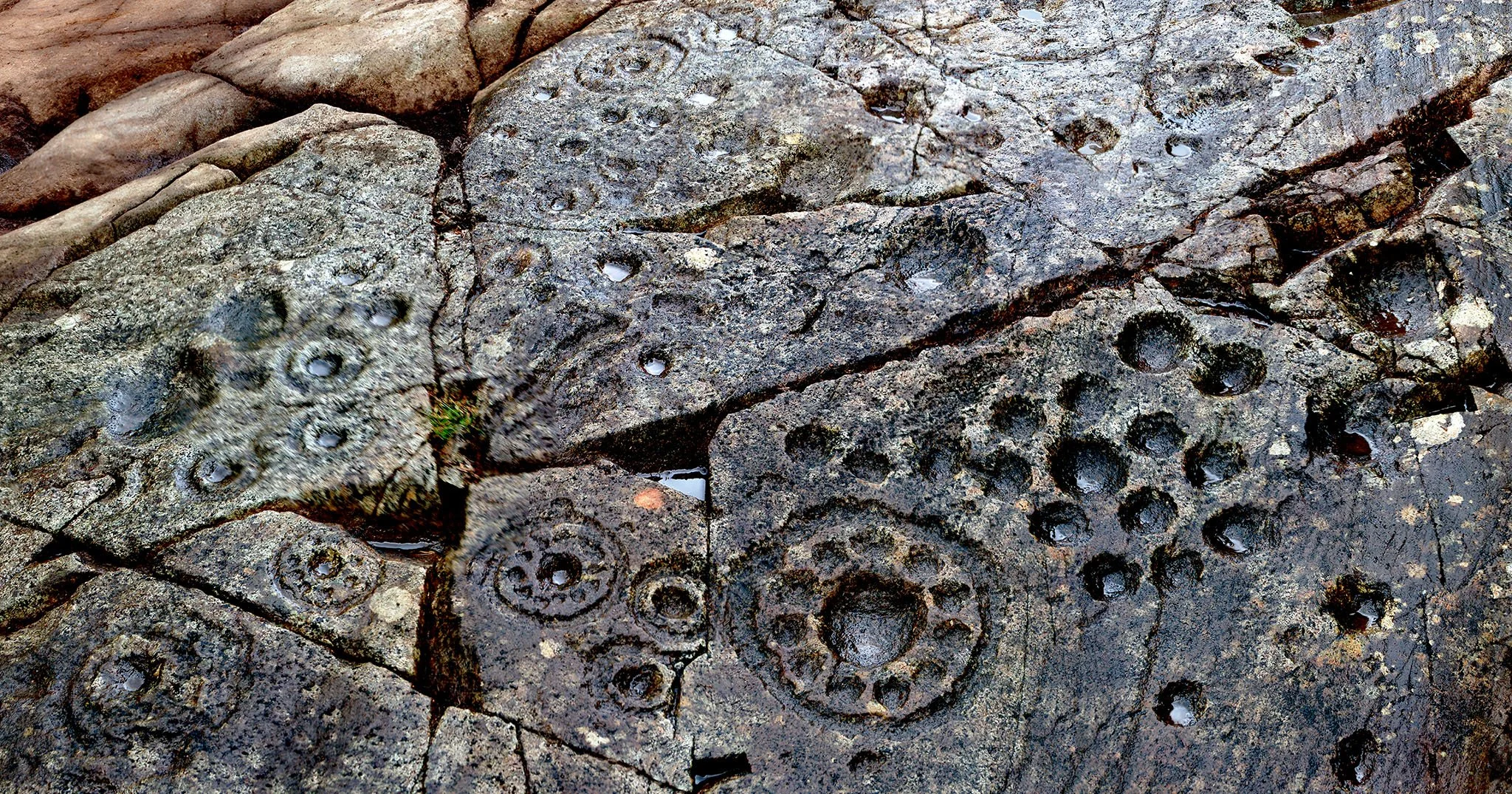
Detail of the cup-and-ring marks at Ormaig.
Ben Lawers: rock art at height
Aaron has co-directed work on the Ben Lawers uplands with Professor Richard Bradley. Working with a small team, they investigated a remarkable group of sites around 500m above sea level - some of the highest rock art in the British Isles.
One objective was to explore the distinction between decorated and undecorated rocks. Excavations around carved surfaces revealed broken quartz, worked flint, and exotic materials, including flakes of volcanic glass and a beach pebble likely brought from the Atlantic coast. Undecorated rocks showed none of this.
Some carved surfaces contained mica, causing them to glisten—echoing the shimmering waters of Loch Tay below. At one outcrop, an area of compacted ground marked a clear viewing position, from which a complex motif could be seen set against the wider landscape. This may have been a place not only to see the carvings, but to gather—to participate in events structured around the rock. Environmental evidence collected close to this carving suggests it was made in an open landscape very similar to that seen at Ben Lawers today.
Alongside the excavations, a touring photography exhibition was staged by National Trust Scotland, and the project featured on the BBC Alba television documentary, Talamh Trocair.
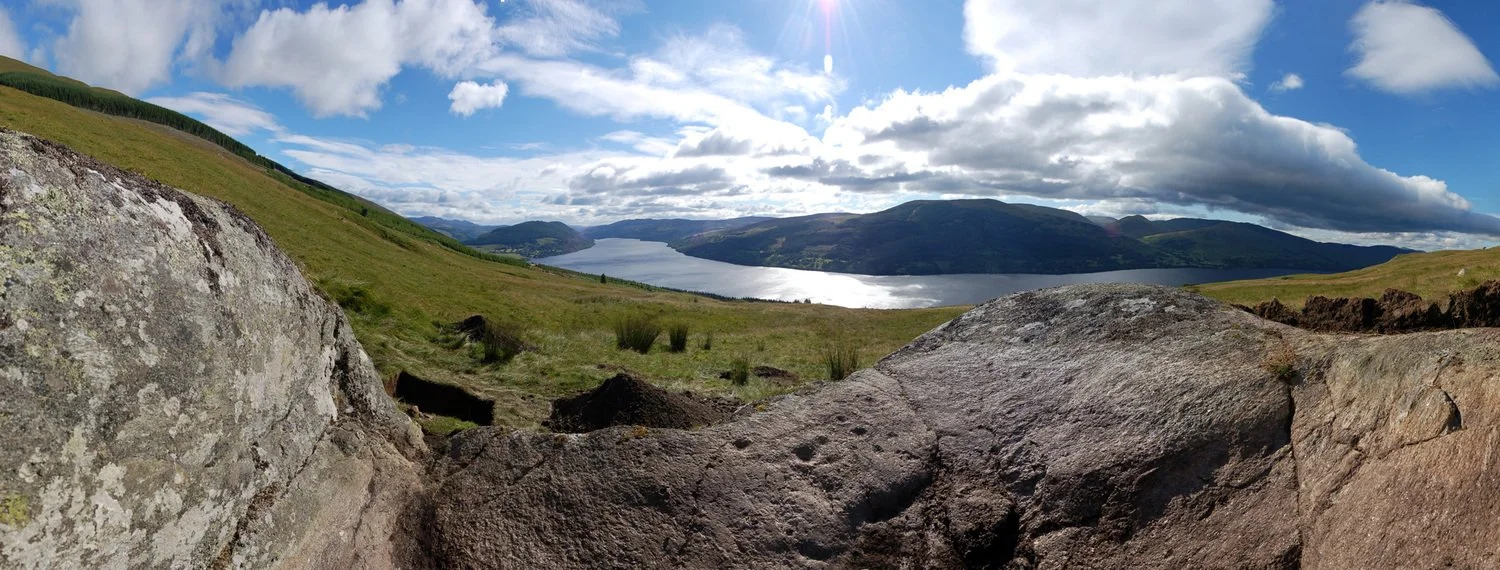
The view across Loch Tay from one of the rock art panels on Ben Lawers.
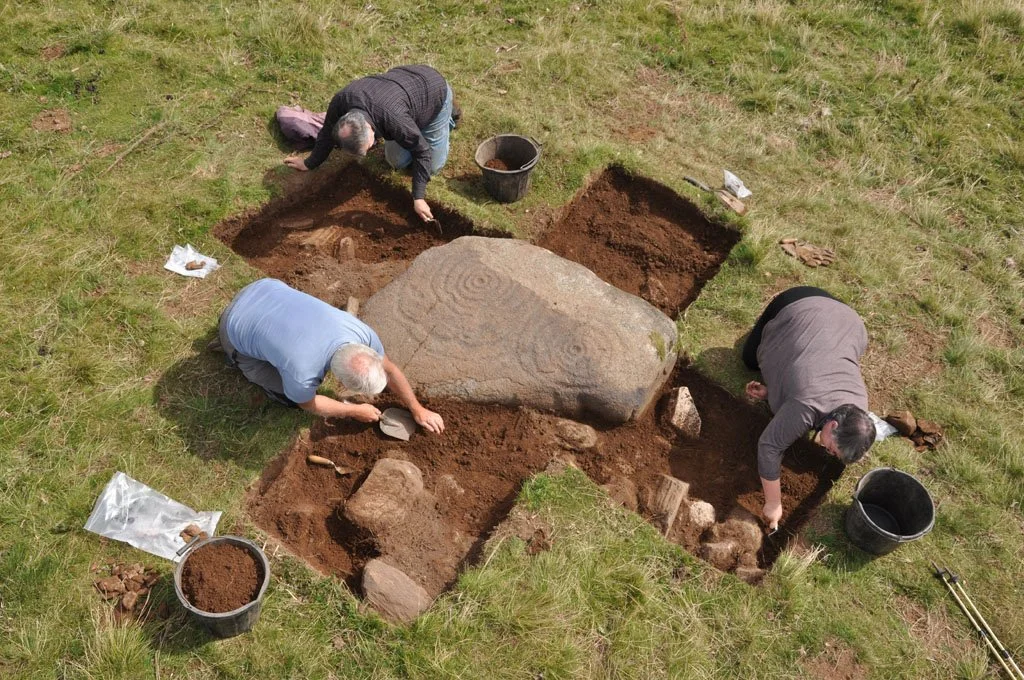
Excavating a carved rock art on the Ben Lawers project
Conclusions:
What rock art may have meant in the Neolithic
Taken together, this work suggests that rock art was part of a wider sensory landscape. Its placement draws on geology and topography; its visibility shifts with light, particularly the low winter sun; its creation generated sound and movement. Sites connect along pathways and sightlines, linking people, places, and moments in time.
Rather than fixed symbols with a single meaning, these carvings seem to have operated through experience—through the interplay of optics, acoustics, and the material qualities of stone.
Rock art was not only something to be seen. It was something to be encountered.
Find out more about prehistoric sensory experiences >
Fieldwork and research sites
Fieldwork and Research Sites
Research is ongoing, and further findings will be shared on this site as the work progresses.
Further reading
An Animate Landscape: rock art and the prehistory of Kilmartin, Argyll, Scotland. Oxford: Windgather Press.Jones, A., Freedman, D., O’Connor, B., Lamdin-Whymark, H., Tipping, R., Watson, A. 2011.
Ben Lawers: Carved Rocks on a Loud Mountain, by Richard Bradley and Aaron Watson. 2012. In Visualising the Neolithic: abstraction, figuration, performance, representation, edited by Andrew Meirion Jones and Andrew Cochrane. Oxford: Oxbow.
< Click for Amazon
Excavations at Four Prehistoric Rock Carvings on the Ben Lawers Estate, 2007-2010, by Richard Bradley, Aaron Watson and Hugo Anderson-Whymark. 2012. Proceedings of the Society of Antiquaries of Scotland 142, 27-61.
< Download free PDF from Archaeology Data Service
Four Sites, Four Methods, by Aaron Watson. 2012. In Image, Memory and Monumentality, edited by Andrew Meirion Jones, Joshua Pollard, Julie Gardiner and Michael J. Allen. Oxford: The Prehistoric Society and Oxbow, 307-27.
< Click for Amazon